
Rainbow Day! May 18-19 in 2023!
Rainbow Day, יום ברית הקשת
Remember the Rainbow Covenant on Shabbat Noach, Shabbat Behar and Rainbow Day!
Celebrate Rainbow Day and the Rainbow Covenant with all life! The Rainbow Covenant with all life is the first covenant of the Torah, and in the Noah story it takes place on the 27th day of the second month.
In the Rainbow Day curriculum, you’ll find Torah, prayers and liturgies, midrashim about rainbows, lesson plans about seed-saving, learning from Hoshea and Ezekiel, Kabbalah and science and art, and project ideas—39 in all—that you can use to celebrate the Rainbow covenant on Rainbow Day, or Shabbat Noach or Behar, or anytime you want to bring a Jewish focus to environmental issues.
In 2023 Rainbow Day falls on May 18-19, in the week after we read Behar-B’chukotai. (Note: this curriculum does not include material related to the pandemic and its impact on our lives. If you want to read something connecting our current reality to Shmitah, try this article: “Can COVID teach us about Shmitah IRL?”)
You can download in-depth study sheets on the connection between the Rainbow covenant and the Sinai/Shmitah covenant with the land here. Go to the Shmita Project to learn more about Shmita.
DOWNLOAD the Rainbow Day curriculum HERE. It includes: the Rainbow and Shmitah covenant Torah texts, poetry for kids, liturgy, song and midrash, frogs and color perception and science, mikveh meditations, the dangers of triclosan and oxybenzone (found in anti-bacterial soap and sunscreen), hydrofracking in Israel, and much more. Some of the specific materials and source sheets can be downloaded as attachments on the left of this page.
A table of contents with a list of all 39 modules, along with the ages each is appropriate for, can be found below. Many individual modules have study sheets, articles, and lesson plans that you can download directly below. You can add your ideas to this curriculum too: write to R’ David Seidenberg of neohasid.org (rebduvid86 at gmail.com). New to this year’s curriculum: the Zohar on diversity; and protesting pipelines. Don’t leave this page without taking a moment to listen to the Hoshea covenant song — scroll down to find the video link!
What is Rainbow Day?
On the 27th day of the second month, Noah, his family, and all the animals that were with them left the ark (Genesis 8). Exactly one lunar year and ten days before—one complete solar year—the flood began on the 17th of the second month, the day before Lag B’Omer. When Noah, the animals and his family went out from the ark, God made a covenant, with all the animals and the people, that there would never be again be a flood of water to destroy life on Earth. Rainbow Day is always the 42nd day of the Omer, the day before Yom Yerushalayim. Other special days connected to the Rainbow Covenant include Shabbat Noach and Shabbat Behar.
Why is the Rainbow Covenant important?
The Rainbow Covenant is a time to celebrate the diversity of life on Earth, and to remember our role in God’s covenant with all Creation. It is a time to remember that the first covenant was not with human beings but with all living creatures. It is a chance to reflect on the deep spiritual and religious meaning of diversity, creation, and our role as part of creation and partners with God.
What is the message of the Rainbow Covenant?
The Torah teaches that God has promised never to flood the Earth again. But that doesn’t mean humanity can’t “flood the Earth” and harm life. We live in a time when many species have gone extinct or are threatened with extinction. Our civilization is using so much of the world’s land and resources that we don’t always leave room for the other creatures. And the climate is changing. As the African-American spiritual goes, “God gave Noah the Rainbow sign, no more water, the fire next time!” The story of Noah and the Flood teaches us that we have a responsibility to care for all creation and all creatures, and that caring for all species is a mark of righteousness.
What can you do to celebrate the Rainbow Covenant?
The resources here will include ideas for teachers and educators, for kids and adults, for rabbis and prayer leaders, gardeners and meditators, for Torah study, science study, and for action. Find a venue where you can make a difference and use one of these modules. Leave a few moments after whatever activity you use for teaching the traditional blessing for seeing a rainbow. The simplest version of that blessing is:
Blessed be You YHVH, our God. . .who remembers the covenant.
Barukh atah Adonai Eloheinu melekh ha`olam zokher et habrit.
You can use also these materials on Shabbat Noach, Shabbat Behar, or other days!
Download the Rainbow Day curriculum!
You can also incorporate ideas you’ll find here into the observance of Yom Yerushalayim, or as part of Lag B’Omer or for anytime of the Omer, etc. Or use them in religious schools in the week following Shabbat Behar or anytime. Whether you do something in a group, a synagogue, with friends or on your own, make Rainbow Day special.
Here is a prayer that you can use for Rainbow Day (longer version with vowels is found below, and this version with vowels is found in the curriculum as well):
אל מלא רחמים God full of compassion,
זכור בריתך עמ כל החיים remember Your covenant with all life,
ברית מי נח the covenant of the waters of Noah.
ופרוש סכת רחמיםושלום Spread a Sukkah of compassion & peace
עלינו ועל כל מיני החיים over us, over all Life’s species.
הקיף כלם יוחסינו Surround all our relations
בזיו השכינה with Shekhinah’s radiance,
בנחל עדניך תשקם Water them with Your river of delights
בכל מושבותהם in all of their habitats.
ואז ישוב עץ החיים Then the Tree of Life will be restored
לאיתנו הראשון to its original strength,
ונראתה הקשת בענן and ‘the bow will appear in the cloud’
שש ומתפאר בגוונין joyful and beautified with its colors,
ותזכנו אנחנו וצאצינו so that we and our descendants may merit
לישב ימים רבים על האדמה to live many days on Earth,
כימי שמים על הארץ like days of the Skies over the Land.
You can find more versions of this prayer and other Earth prayers on neohasid.org.
Songs! => Hoshea 2:20 describes a messianic rainbow covenant that is yet to come:
V’kharati lahem brit bayom hahu im chayat hasadeh v’im of hashamayim v’remes ha’adamah v’keshet v’cherev umilchamah eshbor min ha’aretz v’hishkavtim lavetach
“On that day, I will make a covenant (for them) with the beasts and the birds, with all creatures that walk on the Earth, that bow and sword and battle will disappear from the land, so that all may safely rest.”
You can hear a song written by Shimshai to these words on youtube by clicking the image below, or you can here an audio only version by Amen (Gaby Meyer and Amir Paiss) here!
More thoughts on the Rainbow Covenant:
According to Kabbalah, Rainbow Day is also the day of Malkhut in Yesod, a unity of masculine and feminine that represents a milestone on the way to the revelation of Shavuot. For us, it can represent a chance to commit ourselves to the rainbow covenant, to turn from actions that destroy the earth, to turn our lives away from unraveling earth’s climate and the web of life, from diminishing earth’s abundance.
The rainbow signified a new covenant between God and the land. It’s time for us to imagine a new covenant between humanity and the Earth, including the land and the seas, one that we start to live by as we change our lifestyles and habits. We can use the covenantal vision of the Shmitah year in Leviticus 25 to help guide our steps. And maybe next year it will be time to celebrate that new covenant.
Rainbow Day is pregnant with ritual possibilities related to the elements, to the midpoint between equinox and solstice, to the time between the fire of Lag B’Omer and the fire of Sinai, to global warming, to healing the waters, to the growing wheat crop in the land of Israel, and to all the meanings related to the journey from freedom to revelation. And rainbows are a symbol of diversity: the diversity of colors, of people, and of all life.
Download the Rainbow Day Curriculum!
Curriculum Table of Contents (* are newer or were substantially updated in 2018):
Contents (version 6.1):
The Rainbow Blessing
1. Teach the Rainbow blessing and blessing the trees (all ages)
Texts from Tanakh
2. The Rainbow covenant in Genesis (older kids and up)
3. A Tale of Two Covenants: Rainbow and Shmita (adult)
4. Hoshea and the Messianic covenant (adult / all ages)
Songs:
5. A song for the Hoshea verse (all ages)
Midrashim: interpretations of the rainbow sign
6. Ezekiel, and a Kabbalistic interpretation of the rainbow (adult)
7. Noah and environmental responsibility (older kids and up)
8. Flood, Ark and Rainbow, R. Arthur Waskow (also for Lag B’Omer) (older kids and up)
9. Human responsibility, R. Shlomo Riskin (older kids and up)
10. The diversity and unity of all life, R. Shimshon Rafael Hirsch (older kids and up)
11. On human moral development, R. Avraham Yitzhak Kook (link) (adult)
12. * The rainbow and diversity – an interpretation of the Zohar (older kids and up)
Biodiversity
13. Learn about biodiversity (link) (resources for all ages)
14. Pick a rainbow! (kids, all ages)
15. Study endangered species (focus on frogs) (ideas for younger, older kids, and up)
Science, Culture and Art
16. How many colors are in a rainbow? (all ages)
17. Do other animals see colors the way we do? (all ages)
18. Colors and dyes (all ages)
19. The science of rainbows (ideas for younger, older kids, and up)
20. Art projects (kids and playful adults, all ages)
21. Poetry! (kids)
Liturgy and Prayers
22. Rainbow prayer for creation, R. David Seidenberg (adult)
23. Council of All Beings (link) (older kids and up)
24. A mikveh meditation, Carol Rose (older kids/adult)
Current Issues
25. Global climate disruption, aka climate change (older kids and up)
26. * Hydrofracking (older kids and up)
27. * Fracking in Israel and “energy security” vs. solar (older kids and up)
28. * Pipelines (older kids and up)
29. The Farm Bill (older kids and up)
30. * Common deadly chemicals in anti-bacterial soap and sunscreen (all ages)
31. Tzedakah and justice (kids and adults together)
Seed Saving, Harvests and Gardens
32. Seed saving and Naamah (all ages)
33. Read Naamah: Noah’s Wife by Sandy Eisenberg Sasso (younger kids)
34. For the Omer: plant a “grainbow”! (all ages)
35. Eli Rogosa’s story about finding an ancient wheat (older kids and up)
36. Plant a rainbow garden (link) (all ages)
37. Count the omer! (link) (all ages and adult)
The Seven Noachide Laws
38. The seven colors of the rainbow and the seven laws (adult)
39. More study ideas (adult)
♦ These organizations contributed resources to the curriculum:
neohasid.org | The Shalom Center | The Teva Learning Alliance | Jewish Farm School | Kayam Farm | Religious Action Center | Green Zionist Alliance (now called Aytzim)
These organizations helped to publicize Rainbow in the first two years of this project: Isabella Freedman Retreat Center | Jewish Reconstructionist Movement | Eden Village Camp | Organic Torah Tikkun | Schechter Day School Network (now part of Prizman) | EcoJews of the Bay | Green Zionist Alliance | Coalition on the Environment and Jewish Life | Jewish Greening Fellowship | Hazon | Urban Adamah | Wilderness Torah | Adamah
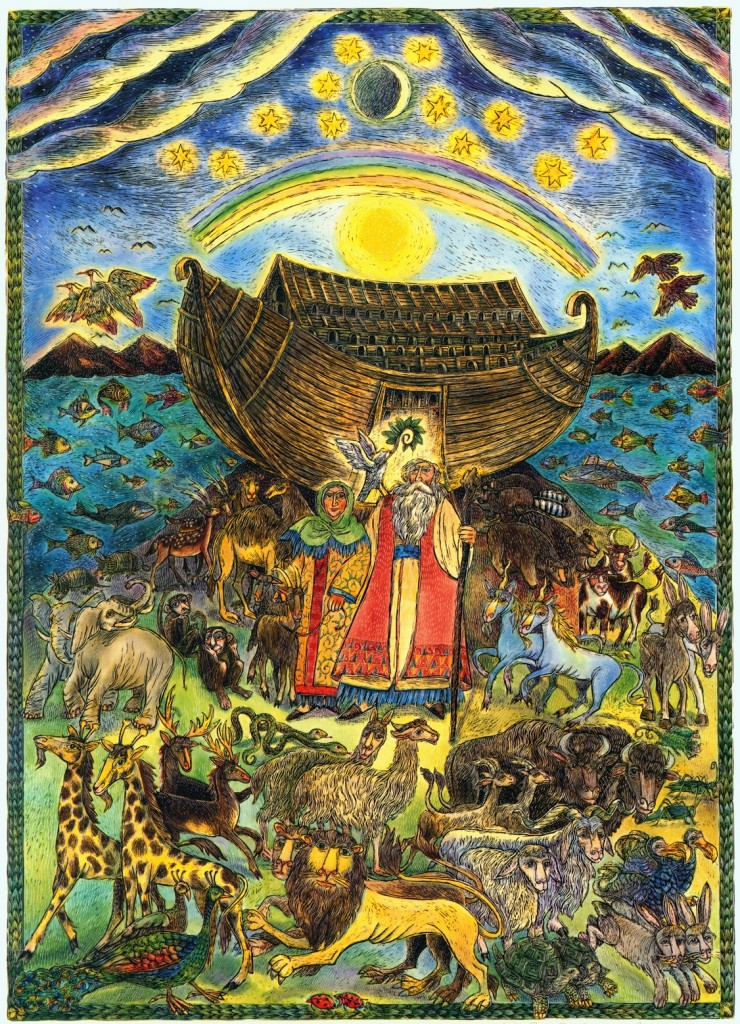
The beautiful illustration below is “Noah & Naamah” ©1998 by Ilene Winn-Lederer; Prints may be ordered at: http://www.winnlederer.com/finearts/prints2/noah.html or via email to: ilene@winnlederer.com
♦ More: Jewish Lights has published two versions of Sandy Eisenberg Sasso’s book about Naamah: Naamah, Noah’s Wife, ages 1-4 and Noah’s Wife: The Story of Naamah, ages 4 and up.

Got something to say?
You must be logged in to post a comment.